


AI Governance & Cloud Cost Optimization
Know what AI and cloud cost. Prove what you saved.
Why are cloud and AI costs so hard to control?
AI is not too expensive. Ungoverned AI is. An AI use without an owner, an approval and a price is not a technology problem. It is an operating problem, and it has a specific, measurable solution.
Every organization adopting AI is having the same three conversations:

From Finance
“The AI line doubled and I cannot say which team spent it. I need an answer before the budget review.”

From Engineering
“We have assistants and agents everywhere. Half of them nobody approved. We find out when the invoice arrives.”

From Leadership
“The board is asking what AI costs us and whether it is under control. Who owns that answer?”
Cloud and AI are the two budget lines that grow without a purchase order. They are consumed, not purchased: one deployment and one prompt at a time, by teams doing their jobs. The bill arrives later, and it records the total, not the cause. Spend is decided in four places, and the invoice shows only the last one.
BOUGHT
Licenses, commitments and model access are purchased
WHAT GETS LOST
Price and term are known here, then lost
BUILT
Teams deploy workloads and configure assistants and agents
WHAT GETS LOST
The design choices set the cost, but no price is attached
CONSUMED
Compute hours, storage, tokens, seats and agent credits meter up
WHAT GETS LOST
Spend grows with no purchase order
INVOICED
A total arrives from each provider
WHAT GETS LOST
Cause, owner and approval are not on it
The answers exist at every stage, and they were never joined together.
That is the whole problem, and it is a fixable one.
29%
of cloud spend is estimated to be wasted, the first rise in five years
(Flexera, 2026)
81%
say AI cost is not yet fully accounted for
(Mavvrik / Benchmarkit survey, 2026)
40%
had AI cost reach the board before the explanation did
(Mavvrik / Benchmarkit survey, 2026)
5-30x
the tokens an agent uses compared with a chatbot for the same task
(Gartner, 2026)
What does good AI governance look like?
Governance decides what may run. Cost optimization proves what it costs. Most organizations treat them as two programs run by two teams, and most governance frameworks never ask what a use will cost. Ours asks at two of the six gates, and the answer follows the use for as long as it runs.
Six gates, six plain questions
- Admit. Is it real, and who owns it?
- Evidence. Does it work on our data, and at what cost?
- Fund. Is it worth the predicted cost range?
- Readiness. Are the controls in place?
- Rollout. Is it holding up at scale?
- Re-review. Does the actual cost still justify it?
Nothing moves to the next phase until its question is answered with evidence, and every answer is recorded with who gave it and when. That record is the audit file. It assembles itself as the use moves through the gates, instead of being reconstructed the week an auditor asks for it.
Three risk tiers, not one path
Not every AI use deserves the same scrutiny. A drafting assistant and an agent that affects benefits, hiring or customers should not go through the same review. Three risk tiers decide how much evidence each gate needs: standard uses take a short path, a form at intake, a weekly review and a spend cap, and are running the same week. The full framework is reserved for the few high-impact uses that need it. Controls are mapped to the four NIST AI Risk Management Framework functions, Govern, Map, Measure and Manage, and tracked by use case, so every gap has a name and a date.
Where cost joins the decision
Gates three and six are the ones most frameworks lack. A use is funded at Fund against a predicted low, expected and high cost, and it is kept at Re-review against the verified actual. In between, three events trigger a re-review on their own: cost leaves its range, the model changes, or an incident is logged. An approval without a price is a wish. An approval with a price, checked every month, is governance.
What federal policy already requires
For agencies, the policy is in force. Chief AI Officers must track AI spending, high-impact uses need a cost analysis, and IT vendors must disclose utilization and prices paid. OMB M-25-21 sets minimum practices for high-impact AI: an inventory, impact assessments, pre-deployment testing, human oversight and ongoing monitoring. A governance record built this way produces the use-case inventory, the utilization and price disclosures and the cost analysis from the same data, instead of three separate reporting exercises each quarter.
Not sure which tier your AI uses fall into?
A 30-minute governance review walks through your current inventory, assigns a provisional tier to each use and shows which gate each one is at. No access required.
How does Digital Compass Operate?
One partner, six steps, one record
Most organizations buy the first four steps from three or four different providers, each with its own view. We add the last two, and what Manage proves on the invoice becomes the evidence for the next purchase.

A gate stands between each phase and nothing moves to the next phase until its question is answered with evidence.
AI Readiness & Use-Case Assessment
Every AI use, live or proposed, with an owner, a risk tier and a cost range
Governance Framework Design
Decision rights, six gates and a control checklist by tier, aligned to NIST AI RMF and OMB M-25-21
Model Configuration & Automation
Models configured to the task; agents built with evaluation, caps and human oversight
STEP 4
Cost Baseline & Ownership Map
Read-only bill review; every dollar and token allocated to a cost center and owner
STEP 5
Managed Optimization
A named analyst works the levers weekly and follows each action to the invoice
STEP 6
Agent Cost Prediction & Guardrails
A cost range for each agent before it is built; step and spend caps once it runs
What sets us apart?
We hold the price you paid
As your reseller, every order starts on the record with its price, quantity and term.
We run the environment
We operate cloud, infrastructure, devices and licenses day to day, so a finding becomes a change the same week, made by the people who own it.
Our approvals carry a price
No AI use is funded without a cost range or kept without a verified cost.
We sign the number
Our delivery lead signs the monthly record.
What is DigiPulse?
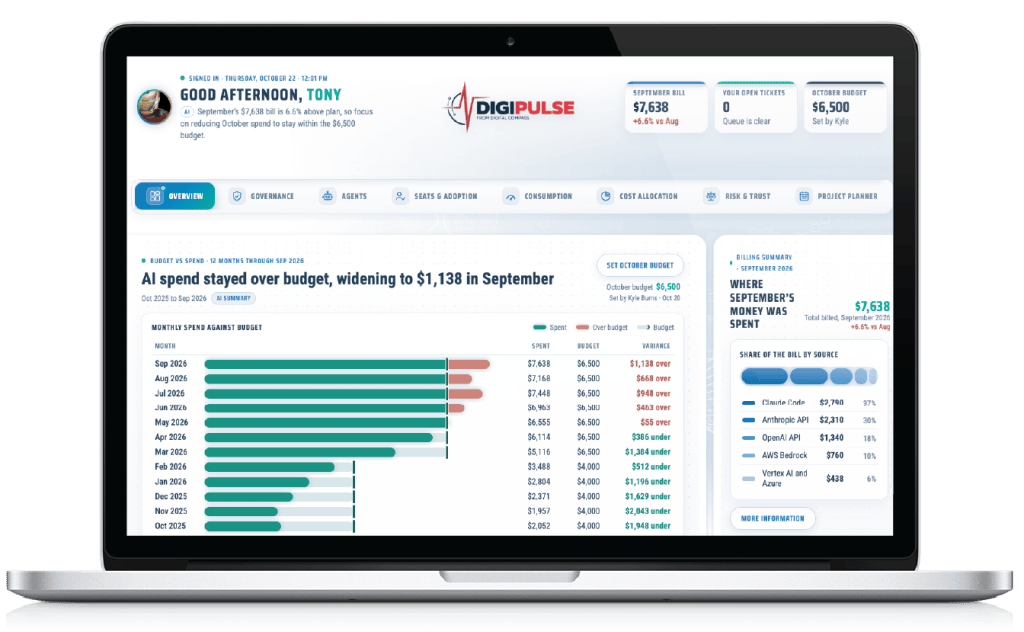
DigiPulse is our system of record for your cloud and AI estate. It keeps one line per asset and per AI use: what was bought and at what price, what was built and for whom, who uses it, who approved it at what risk, and what it cost last month.
Connect
Read-only access to billing exports, usage APIs and admin reports. Nothing installed, no content read. A renewal due brings its usage data with it.
Standardize
Every source converted to one format, in dollars: instance hours, tokens, seats and vendor credits.
Watch
Budgets, daily limits and alerts keep the waste from returning. An idle license is reclaimed; spend over its daily limit is capped.
Assign
Every dollar and token tied to an owner, an application and the outcome it served. An unapproved AI use is sent to the gate.
Start where you are.

Do you have a purchase or renewal coming?
Start with a bill review. We measure use before the order is signed.

Are you building or planning an AI agent?
Start with Agent Cost Prediction & Guardrails. We predict its cost as a range, register it and take it through the gates.

Do you already have cloud and AI running?
Start with the Cost Baseline & Ownership Map. We return a baseline and a ranked action list.
Five questions any AI or cloud partner should answer.
A fair test for any partner, including us:
- Which business unit spent our AI budget last month, and on what?
- Which AI uses are running, who approved each, and at what risk tier?
- What will the next agent cost, as a range, before it is built?
- What did you save us last month, on which invoice line?
- Can you show the file an auditor would ask for, today?
Ready to see what is hiding in your AI and cloud bill?
Frequently Asked Questions
Who can help my company govern and optimize AI spend?
A partner that approves AI uses with a cost range, allocates every dollar and token to an owner, and verifies savings on the invoice. Digital Compass does all three, as your reseller, operator and governance lead, on one record.
Who should own AI and cloud cost?
Every AI use has a named business owner. One accountable AI lead, often the CIO, CTO or head of data, chairs the weekly review. Finance sees spend by owner. Owners never approve their own uses.
How do I control token and API costs for AI applications?
Predict a low, expected and high cost before the build, cap the steps and the spend once it runs, apply caching, right-size the model, and verify the cost per ticket or task each month.
How long until we see savings?
Access is read-only on Day 1, the baseline is ready by Day 30, and the first saving is confirmed on an invoice by Day 90.
What data do you access?
Read-only billing exports, AI usage metering and purchase records. Prompts, outputs, documents, credentials and production systems never leave your environment.
How do you handle federal requirements?
Chief AI Officers must track AI spending, high-impact uses need a cost analysis, and vendors must disclose utilization and prices paid. Our governance is aligned to the NIST AI Risk Management Framework and the OMB M-25-21 minimum practices for high-impact AI, and the same record produces the use-case inventory, the utilization and price disclosures and the cost analysis the policy asks for. Data boundary and hosting options are set in writing before access is granted.
What should a managed cost optimization service include?
A baseline and ownership map, weekly work on the cost levers, owner approval before any change, a monthly savings record that separates savings from avoidance, predicted ranges and caps for new AI agents, and a quarterly business review.